

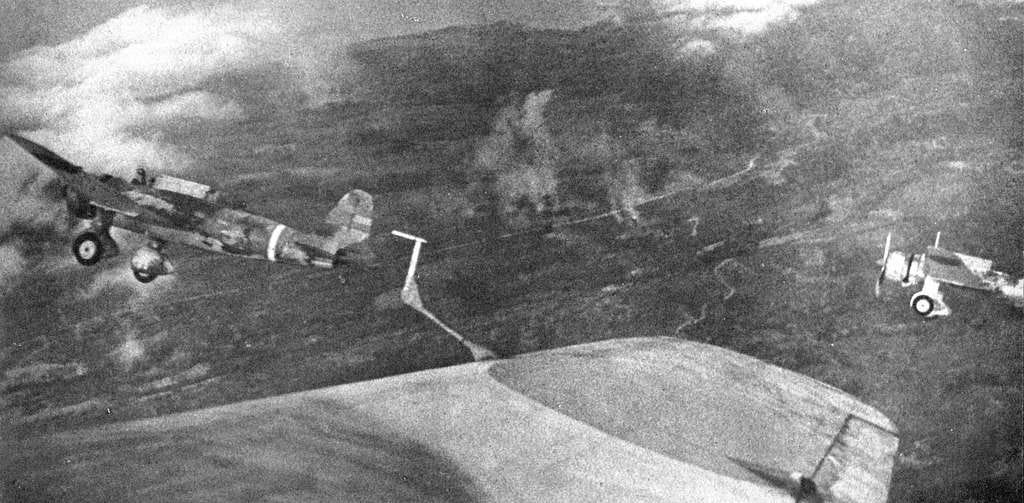
Japanese Army Air Force Mitsubishi Ki-30 (Allied code name “Ann”) bombers flying over the main line on Bataan in 1942 (Source: Wikimedia Commons).
Shocked, the Front Line Reels
As April 4 dawned, General Edward King’s Luzon Force tried to hold its defensive position in Sector D of the Orion‑Bagac line. But the combat heat of the Rising Sun melted away almost all resistance. The 41st Division was destroyed the previous day, and the 21st Division, bloodied but still in place, dug in overnight to brace for the next wave of the Japanese onslaught.
Japanese General Masaharu Homma was pleased with the first day’s progress. He had expected the Imperial Japanese Army would need a full week to capture Mt. Samat, but the success of April 3 convinced him to advance the timetable and press his advantage.
The Assault Begins Again
The Japanese resumed the offensive on the morning of April 4 with another heavy artillery attack, coordinated with bombing and strafing runs from the aircraft that ruled the skies. They advanced through the gap left by the decimated United States Forces in the Philippines (USFIP) 41st Division and moved toward Mt. Samat. The heights of that jungle mountain offered vistas from which the controlling force could pinpoint artillery fire on roads, supply points, and assembly areas. The advancing Japanese quickly threatened USFIP command of the mountain stronghold. Mt. Samat was becoming the fulcrum of the first days of battle.
The defensive line that the diminished USFIP 21st Division had improvised the night before came under fierce Japanese attack. The Japanese Army pushed into positions that outflanked elements of the 21st Division and threatened its right and rear. From there, they broke the USFIP line in localized areas, causing some troops to withdraw and leading to a loss of contact between units.
The Orion-Bagac line in Sector D disintegrated into isolated groups and pockets of resistance, some still fighting, others falling back without clear orders. Relentless Japanese artillery fire cut the communications wires. Officers of the 21st Division tried to stabilize the line with diminishing manpower and incomplete information. They were exhausted, understrength, and increasingly unable to hold Sector D as a coherent front.
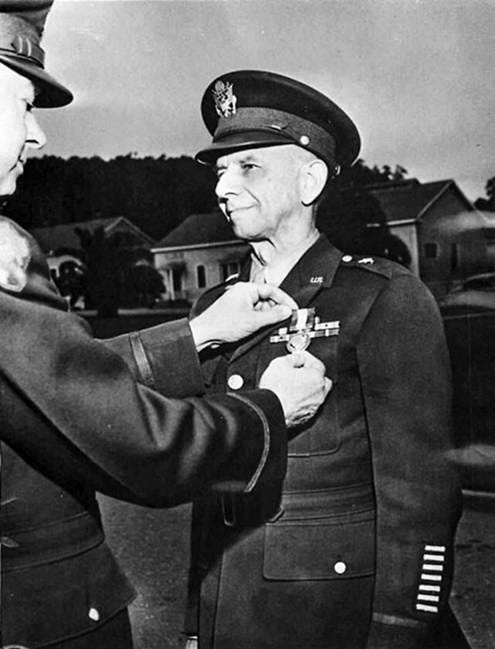
General Clifford Bluemel receives a medal in 1947, after the war (source: Wikimedia Commons).
Bluemel’s Blues: Disquiet on His Western Front
General Clifford Bluemel led the 31st Division, including my grandfather Major Emeterio Asinas, tasked with defending the adjacent Sector C. This part of the line stretched 4,500 yards, the length of 45 football fields. Bluemel commanded 6,500 men, the largest fighting division remaining on Bataan, made up mostly of Filipino reserves like my grandfather. He had sixteen 75‑mm. cannon at his disposal, representing 22 percent of the seventy‑two guns of that caliber available to II Corps, which held the eastern half of the Orion–Bagac line.
General Bluemel was a wily fighter. He knew the initial Japanese attack had not come straight at the 31st Division. Yet. But it might come soon, and when it did, it would come with massive force. He would fight back as fiercely as he could for as long as he could. How could that turn out?
In The Fall of the Philippines, Louis Morton summarized the dilemma about to crash upon General Bluemel:
At the end of the day’s action, the Japanese were in possession of the entire main line of resistance in Sector D. The 41st Division had been routed and the 21st forced back to the reserve line in front of Mt. Samat, its left flank [exposed as if] hanging in the air. The Japanese 65th Brigade had pushed south up the Pantingan [River] valley, twice outflanked the USFIP 41st Infantry, and now stood ready to march unimpeded down Trail 29.
The Japanese were now one day ahead of schedule and in position to storm the heights of Mt. Samat, the first objective of the offensive begun on the morning of Good Friday.
Although General Bluemel’s 31st Division still held its sector, its right flank was increasingly exposed to advancing Japanese forces. With limited reserves and a long front to defend, Bluemel faced the prospect of meeting a major head-on Japanese attack while his division’s flank and rear were already under growing threat.
Unease at II Corps Headquarters
Back at the 51st Division Military Intelligence headquarters, Lt. Felipe Buencamino could tell the tide was turning swiftly. In his April 4 diary entry, he wrote:
HQ, Bataan
The Americans in HPD [Hospital Point Dispensary] are burning their papers. Others are packing their maps and clothes. They are transferring to Corregidor. This is a clear indication that our days here are numbered.
Courier boats leaving for Corregidor are packed with high-ranking officers transferring to the Rock. Personally, I prefer to stick it out here with the men.
The area around HPD, Limay, Lamao is burning. Huge trees are aflame. Craters pock-mark the shell-burnt earth. Hell has broken loose.
Balanga is obliterated. Not a single standing structure. Houses lie in crumbled ruins, mere piles of wood and stone.
The municipal building, the Cathedral, houses around the plaza have been seared by the fire of incendiaries. All along the trails leading to the front are huge bomb craters, gaping shell holes, corpses of brave men.
I saw three Jap planes hedge-hopping in an airfield at Cabcaben then flying off again. Boys machinegunned the planes. Planes came back with bombs and killed the boys.
I saw an American driver turning his truck amid burning bushes. He was singing “Melancholy Baby.” I saw an American motorcycle-messenger weeping. “This is the end,” he told me.
(later)
The lines have broken. Japs with tanks, trucks penetrated the area between the 21st and 41st divisions at the Pantingan River.
I saw Lt. Juan Fernandez, aide of Gen. Capinpin, of the 21st. He said: “I don’t know where Gen. Capinpin is. I can’t find him.” It is believed that the General either committed suicide or was captured by the Japs. The last time he was seen was in the very front, directing boys who could no long fire their Enfields.
Saw troops, frontline men, retreating in disorder. Others had thrown their guns. No more bullets, they said. They were clinging to their bayonets.
Fred asked: “Where is the convoy?”
April 4, Holy Saturday for the Filipino Catholics of the Luzon Force, drew to a close with more Japanese gains compounding more USFIP losses. The Japanese had advanced and seized footholds on Mt. Samat, with unimpeded access to key mountain trails leading to the top. USFIP troops lost territory, cohesion, and manpower. The Orion‑Bagac line bent toward collapse, defended by increasingly exhausted and isolated USFIP fighters. The 21st Division was hanging by a thread as night fell, and General Bluemel of the 31st Division could expect an enormous enemy push at his doorstep soon.
Next post: April 5 - General Bluemel’s Troops Encounter the Enemy
Catch up on earlier posts in the full archive on “The Fighting Filipinos” website.
If you are finding this newsletter valuable, please consider subscribing or sharing with a friend.
Sources:
Louis Morton, The Fall of the Philippines, United States Army in World War II: The War in the Pacific (Washington, D.C.: Office of the Chief of Military History, Department of the Army, 1953). HyperWar: US Army in WWII: Fall of the Philippines [Chapter 24]
John W. Whitman, Bataan: Our Last Ditch (New York: Presidio Press, 1990).
Diary of Lt. Felipe Buencamino III, April 4, 1942 - The Philippine Diary Project
© 2026 The Fighting Filipinos. All rights reserved.