

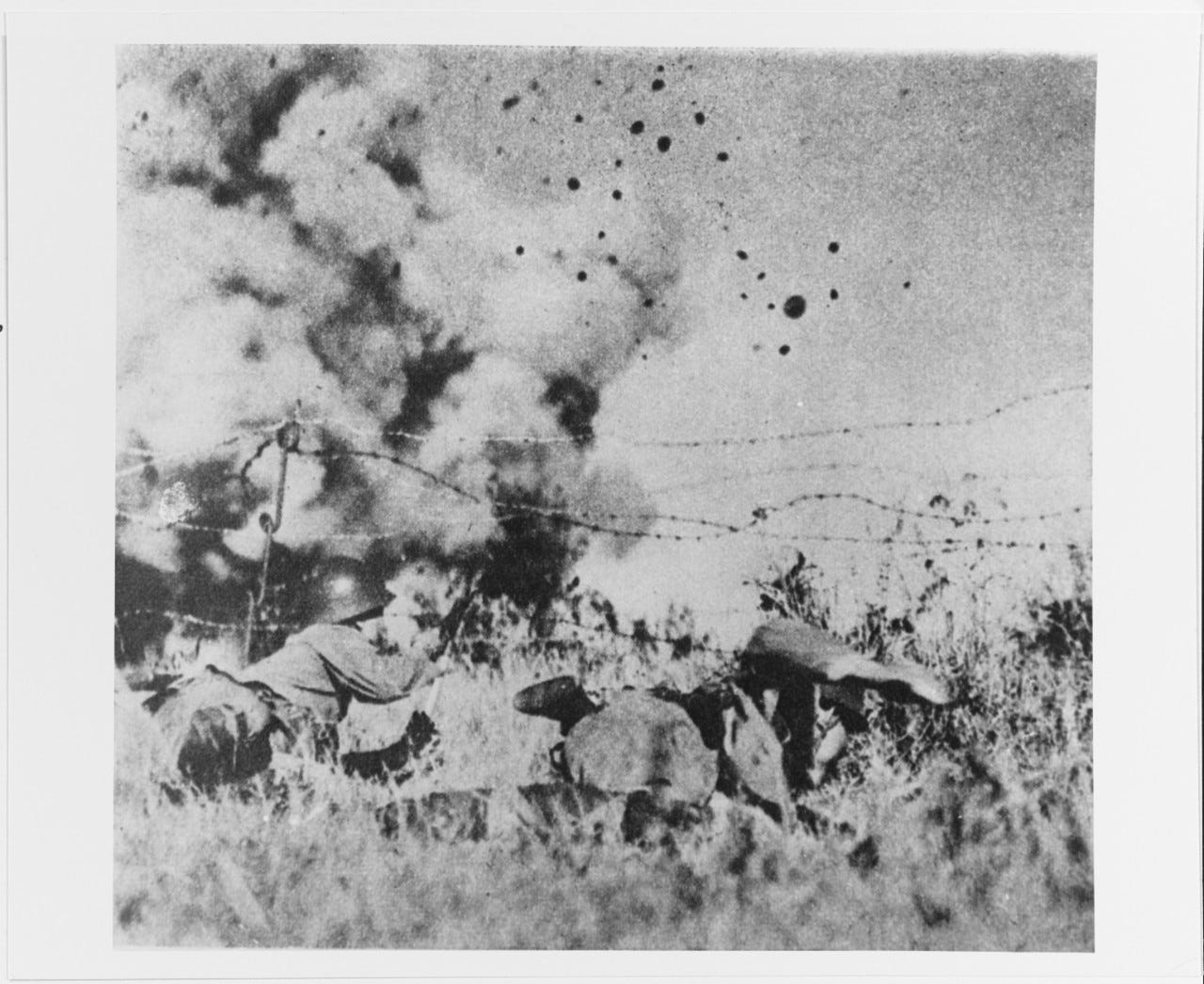
Japanese troops cutting through barbed wire entanglements under cover of an artillery bombardment, on Bataan, 1942 (Source: US Naval History and Heritage Command).
Peril and Planning on the Day of Resurrection
Eighty-four years ago today, also Easter Sunday, Japanese forces continued their rapid advance against the sick and starving troops of the United States Forces in the Philippines (USFIP). General Clifford Bluemel’s 31st Division, including my grandfather Major Emeterio Asinas, came face-to-face with an enemy assault. General Jonathan Wainwright traveled from Corregidor to Bataan to assess the situation firsthand, conferring with General Edward King and then General George Parker on a last‑ditch counterattack. Back at II Philippine Corps headquarters, Lt. Felipe Buencamino observed growing numbers of wounded and dying soldiers flowing back from the front with increasing dismay.
A New Day Breaks Over a Broken Line
“In nómine Patris, et Fílii, et Spíritus Sancti” (In the name of the Father, and of the Son, and of the Holy Spirit).
With these words of the Latin Mass, Filipinos and Americans began the celebration of Easter Sunday during the Battle of Bataan. But it would be an Easter like no other they had experienced. Louis Morton takes up the scene in The Fall of the Philippines:
At dawn, 5 April, the Japanese resumed their devastating air and artillery bombardment. It was Easter Sunday and many of the Americans and Filipinos were attending dawn services “in the fastness of the jungle” when the shells and bombs began to fall. For them the day of the Resurrection was not the joyous occasion it had been in peacetime. The services, wrote one officer, had “a serious atmosphere for us,” and chaplains, invoking divine guidance, did not fail to ask as well for “deliverance from the power of the enemy.”
When Filipino and American soldiers looked to the heavens during Mass, the skies were filled with Japanese aircraft. Fifty-six light bombers and eighty-one heavy bombers attacked USFIP positions on Mt. Samat, unleashing string after string of bombs to clear the way for the next Japanese infantry thrust.
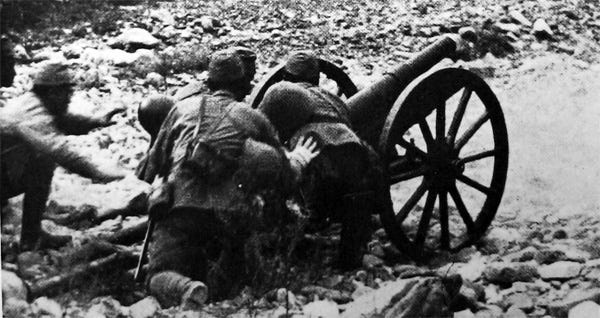
Japanese firing a 75-mm. gun Type 41, normally found in an infantry regimental cannon company (Source: AllWorldWars.com).
Fierce Fighting, Followed by Collapse
At 1000 hours Japanese troops launched an attack on the remaining right flank of the USFIP 21st Division. The sick and starving Filipinos fought back with stubborn, unexpected skill. General King’s combat-tested 41st Field Artillery pinned down the Japanese with fierce barrages from Mt. Samat and the 21st Division troops unleashed what one Japanese officer described as “the fiercest combat in the second Bataan campaign.” Four hours later, this Japanese force was still pinned down.
But the resistance on the right flank would not be enough. The USFIP 21st Division left flank was exposed, and Japanese troops moved rapidly up the trails to Mt. Samat with little opposition. By noontime it was clear that they would take the mountaintop and its critical artillery position. With the Japanese on their doorstep, USFIP soldiers destroyed their equipment, rolled their guns over the cliffs, and evacuated. At 1250 hours Japanese forces took control of the summit of Mt. Samat.
Without artillery support, the USFIP soldiers of the 21st Division right flank were doomed. At 1400 hours the Japanese resumed their offensive, and by 1530 hours the USFIP troops fell back in disarray.
The Japanese continued to roll up the rest of Mt. Samat. At 1630 hours they took the 21st Division command post (CP) by surprise, forcing the USFIP officers to quickly relocate further down the trail. But at 1700 hours Japanese troops raided the new CP and routed the men. They proceeded to locate the remaining battalion of the 41st Field Artillery and forced them to flee, leaving their guns behind.
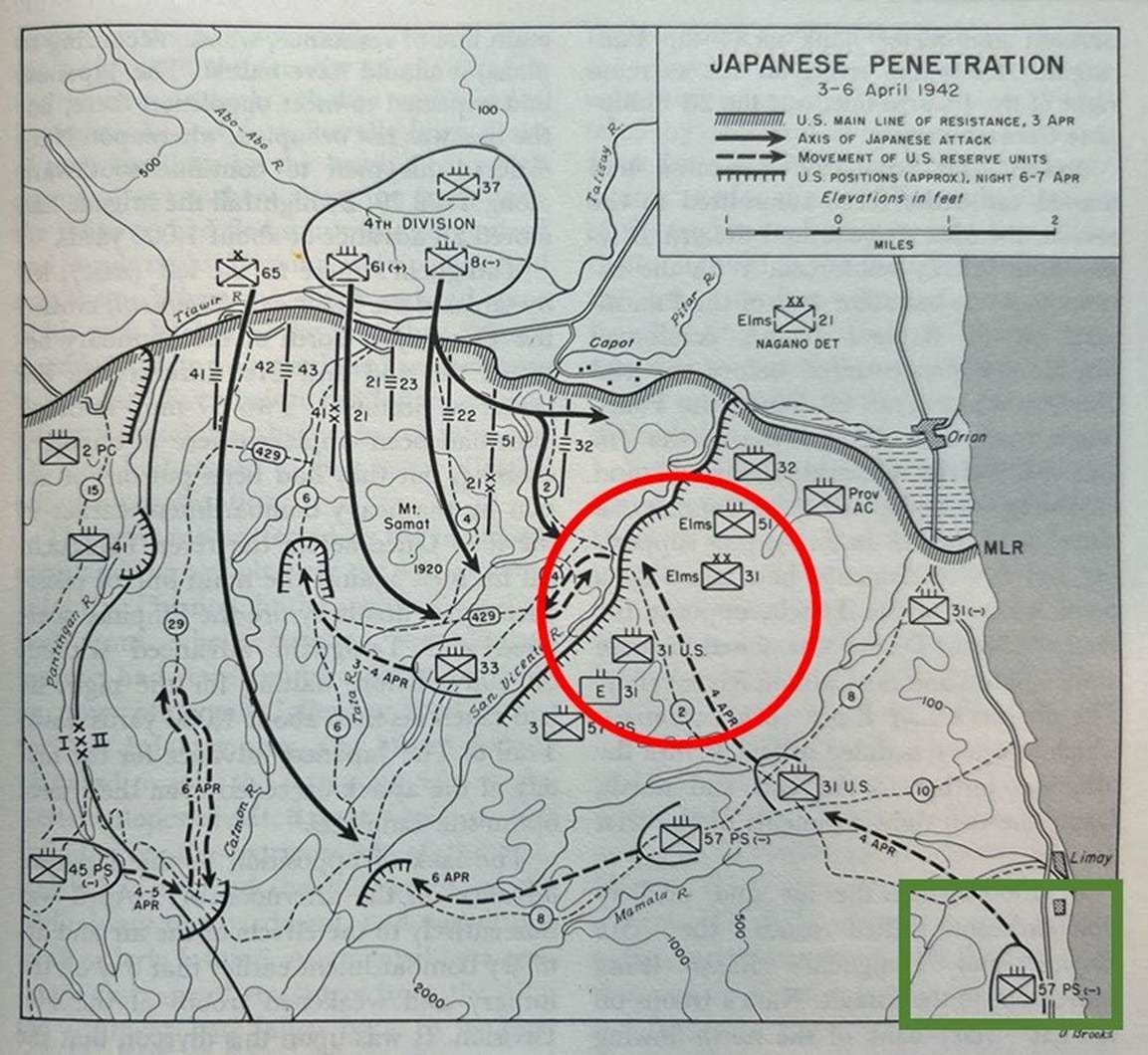
The Japanese Drive to Capture Mt. Samat. General Clifford Bleumel’s Sector C forces including the 31st Division with my grandfather are in the red circle. Lt. Felipe Buencamino at II Philippine Corps headquarters is in the green box (Source: Morton, “The Fall of the Philippines”).
General Bluemel Defends, Only to Be Denied
The destruction of the USFIP 21st Division created an opening on the left flank of General Clifford Bluemel’s Sector C, and the Japanese wasted no time to seize the advantage. Japanese planes bombed one of his command posts six times, and four Japanese tanks emerged from the underbrush to press the attack.
General Bluemel, ever the savvy field tactician, planned his counter-move. At 1200 hours, he requested permission to fall back to the San Vicente River, which formed a natural obstacle in the direction of the advancing Japanese. Bluemel planned to form a line behind the riverbanks to protect the most vital portion of the main line of resistance. If he had to fall back from there, three more rivers would provide natural barriers and allow for a planned, orderly withdrawal.
But General George Parker, commander of II Philippines Corps, denied his request. The generals were planning a counterattack for the next day and Parker wanted Bluemel’s forces in a forward position, able to maintain contact with the 21st Division. It is a measure of the Japanese effectiveness at destroying USFIP communications lines that General Parker may not have fully realized that very little of the 21st Division remained.
Undeterred, Bluemel requested permission to fall back a second time. General Parker again refused.
At 1500 hours General Bluemel received a telephone call from the commander of Sector D, who reported that both the 21st and 41st Divisions were “practically gone.” On paper, the 21st Division had numbered 5,500 men, and the 41st Division 5,900. Since Good Friday, the two divisions, 11,400 men on paper, had been shattered. Thousands had already lost their lives, and the survivors were wounded, starving, or in full retreat.
With irrefutable evidence that there was no 21st Division with whom to stay in contact, General Bluemel requested to fall back again, to no avail. In an odd echo for a battle that began on Good Friday, he had been denied a total of three times.
The Generals Develop a Plan Following MacArthur’s Distant Inquiry
General Jonathan Wainwright decided to leave his fortified headquarters on Corregidor to travel to Bataan and survey the situation firsthand. From far-off Australia, General Douglas MacArthur had ordered Wainwright to launch a last-ditch counterattack, and he wanted to assess its chances for success.
First, he met with General King, who commanded the full Luzon Force defending what remained of Bataan. King ordered that rations be doubled for the troops who would spearhead the counter-offensive, a gamble to generate maximum effort with what little supplies he had left.
Wainwright then sped by jeep to II Corps headquarters to meet General George Parker, responsible for the eastern half of the Orion—Bagac line. Acting on MacArthur’s orders, they agreed to commit their last reserves in a massive counterpunch with all of their remaining resources. This included an artillery barrage from General Clifford Bluemel’s vulnerable position, where he had been ordered to remain.
The operational plan would start at 0600 hours the next day. Theoretically, nine regiments, including reserve forces, would counterattack and form and secure a new defensive line on the slopes of Mt. Samat. For this objective, USFIP planned to mobilize a force of 27,000 men, on paper.
Once more the military theorist Carl von Clausewitz’s concept of “friction,” which was taught in the U.S. and Filipino military academies, appeared over the plans like a haunting, persistent specter. Military plans are worn down by the cumulative effect of unpredictable actions in the field, posited Clausewitz, and the USFIP plan provided a classic example. Despite all good intent, the plan was a folly, which Morton pointed out in The Fall of the Philippines (pages 433-434):
Understrength, weakened by disease and starvation, these regiments were hardly a match for the Japanese. The 31st Infantry…had to leave behind about one third of the men for evacuation to the hospital. Many who should have remained behind rose from their sick beds to join their comrades. Along the line of march, men fell out of rank, too exhausted to continue. The efficiency of those who reached the front line could not have been more than 50 percent.
When Wainwright returned to Corregidor, he sent a message to General MacArthur in Australia to outline his plans. John Whitman recounted his message in Bataan Our Last Ditch (page 498):
The troops have been on half rations for three months and are now on less than that amount which results in much loss of physical vigor and sickness. Nevertheless before allowing a capitulation the operation you suggested will be adopted. I hope however that supplies will arrive in good time. Enemy has been very active on front of Second Corps for past two days with resultant loss of little ground on our part. Situation still serious if not alarming. I counter attack tomorrow.
Ever the resolute leader, Wainwright conveyed his plans forthrightly but likely harbored doubts in his heart. Back on Bataan, he had approved the plans for the counterattack “with misgivings as to the outcome.”
Deepening Despair at II Corps Headquarters
In his Military Intelligence staff role, Lt. Felipe Buencamino III applied his analytical mind to the reports before him and recorded a dour entry in his diary as Easter Sunday closed on April 5:
Bataan
Dead men everywhere. Uniforms red with blood. Guns red with blood. Bataan is a sea of blood.
Some troops still fighting but contact with the main line has been lost. Most of the boys are retreating, firing, retreating, firing—dying.
Saw hundreds and hundreds of unkempt, disheveled, bewildered troops dragging their swollen feet in an attempt to escape from Jap onrush.
An American doughboy, thin, gaunt, skeletal, approached me, asked for “bread, buddy, bread.” I gave him water. I had no bread.
Evacuees are panic-stricken. Saw men, women, children crying…
Divisions have ceased to exist. Regiments are split. Troops are mixed & many platoons have no more officers. Trenches have been abandoned. Everywhere are rifles, broken bayonets, revolvers, staff cars. This is defeat…
Last staff meeting, perhaps, held just a few minutes ago. The General [Simon De Jesus, of Military Intelligence] with tears in his eyes said: we are defeated.
He revealed that a last-minute attempt to stop the onrushing stream of Jap troops was attempted but the battalions of P.C. [Philippine Constabulary] and Scout troops sent were all killed. “Jap tanks not trucks transporting them.”
“That was our last chance, the final hope,” he [General DeJesus] said.
The mess officer was ordered to prepare as much food as he could. “Let us eat as much as we can,” said the Major. “Make it a 3-day supply.”
Meeting abruptly stopped by strafing planes.
I have a fever.
In the theology of Easter Sunday, the rock rolled back from the tomb to reveal resurrection. But in the reality of Bataan, the Filipino and American troops of the USFIP found themselves between a rock and a hard place. By day’s end they had ceded Mt. Samat and lost the artillery dominance its heights once provided. The Japanese now controlled the mountain and the skies above it.
Generals Wainwright, King, and Parker planned a last‑ditch counterattack whose success would depend on soldiers wracked with malaria rising from hospital beds to join their starving comrades and somehow stem the Japanese momentum. General Bluemel, frustrated and exposed, would lend crucial support from the artillery still under his command.
The outcome of the Battle of Bataan hung in the balance, resting on a plan that would require miracles to succeed.
Next Post — April 6: The Counterattack at First Light
Catch up on earlier posts in the full archive on “The Fighting Filipinos” website.
If you are finding this newsletter valuable, please consider subscribing or sharing with a friend.
Sources:
Louis Morton, The Fall of the Philippines, United States Army in World War II: The War in the Pacific (Washington, D.C.: Office of the Chief of Military History, Department of the Army, 1953). HyperWar: US Army in WWII: Fall of the Philippines [Chapter 24]
John W. Whitman, Bataan: Our Last Ditch (New York: Presidio Press, 1990), Chapter 24.
US Navy History and Heritage Command: 80-G-179028 Philippines invasion, 1941-1942.
The War Against Japan. Pictorial Record.
Lt. Felipe Buencamino III, April 5, 1942 - The Philippine Diary Project
© 2026 The Fighting Filipinos. All rights reserved.